Che Guevara’s Death: The Schoolhouse in La Higuera
On October 9, 1967, Ernesto “Che” Guevara was shot inside a small schoolhouse in La Higuera, a remote Bolivian village. He was thirty-nine years old. The day before, Bolivian soldiers had captured him wounded in a ravine. By the time he was killed, the decision to execute him had been made by government and military officials far beyond the village.
His death helped turn him into an international symbol. Yet the man behind the familiar image was more complicated than either a heroic martyr or a simple villain. He was a doctor who became a guerrilla commander, a revolutionary who held senior government posts, and a committed political thinker whose record includes both efforts to change Cuban society and responsibility for executions after the Cuban Revolution.
A doctor drawn toward revolution
Guevara was born in Rosario, Argentina, on June 14, 1928, into a middle class family. He studied medicine at the University of Buenos Aires and qualified as a doctor in 1953. His travels through Latin America, including a long journey with his friend Alberto Granado in 1951 and 1952, exposed him to poverty, illness, and unequal access to land and work. The experience helped shape his political outlook, though it did not transform him in a single instant. His surviving travel notes and later memoir show a young man gradually developing the belief that social problems were connected across national borders.
A more decisive political experience came in Guatemala. Guevara arrived there in 1953, when President Jacobo Árbenz was pursuing reforms that included redistributing some unused land. In June 1954, a CIA backed operation helped overthrow Árbenz’s government. Guevara was not a central actor in the crisis, but he witnessed its consequences and concluded that the United States would use its power to block governments it considered a threat to its interests. He increasingly believed that armed struggle, rather than gradual reform, was necessary.
In Mexico City, he met Cuban revolutionary Fidel Castro. Castro was preparing to challenge the dictatorship of Fulgencio Batista in Cuba. Guevara joined the effort as a doctor, but soon became a combatant and commander.
On November 25, 1956, Guevara and 81 other members of Castro’s expedition left Mexico aboard the Granma, a small yacht carrying far more people than it was designed to hold. They landed in Cuba on December 2. Batista’s forces attacked soon afterward, scattering the rebels. A small number survived and regrouped in the Sierra Maestra mountains. Guevara became one of Castro’s leading commanders during the guerrilla war.
Batista fled Cuba on December 31, 1958. Castro’s forces took power in the days that followed, and Guevara entered Havana in January 1959.
Revolution and government
Guevara moved quickly from the battlefield into government. He held important positions, including president of Cuba’s National Bank from 1959 to 1961 and minister of industries from 1961 to 1965. He travelled abroad as an emissary for the new government and argued for a socialist economy built around public ownership and planned production. He also supported Cuba’s literacy campaign, which was carried out nationally in 1961.
His government record remains deeply contested. Guevara served as commander of La Cabaña fortress in Havana, where revolutionary tribunals tried people accused of crimes under Batista and of opposing the new government. Executions followed. Guevara supported the tribunals and played a role in supervising them. Historians disagree about how to interpret the proceedings, their fairness, and the scale of the killings. His defenders emphasize that the new government was dealing with officials associated with Batista’s repression. His critics point to executions without the protections of a full, independent legal process.
By 1965, Guevara had left his public posts and Cuba. In a farewell letter, Fidel Castro read publicly that October, Guevara said he was giving up his official positions and Cuban citizenship. He had chosen to take part in revolutionary struggles elsewhere.
His next campaign was in the Congo, where he joined forces attempting to support an insurgency. It lasted about seven months in 1965 and ended in failure. The local movement was divided, and Guevara’s small Cuban contingent struggled with poor coordination, difficult conditions, and limited support. He left convinced that the campaign could not succeed.
Bolivia and the isolation of the guerrillas
Guevara’s next destination was Bolivia. He hoped that a guerrilla movement there could inspire wider rebellion across South America. He entered the country in November 1966 under a false identity, posing as an Uruguayan businessman named Adolfo Mena González. His disguise included a shaved head and altered appearance.
The campaign faced serious problems from the start. Bolivia’s Communist Party did not provide the support Guevara expected. Party leader Mario Monje and Guevara disagreed over who would direct the movement, and the relationship between the guerrillas and local political organizers remained strained. The rural communities Guevara hoped to draw into the struggle did not rise in support of his group. Some people were wary of the armed outsiders; others passed information to the authorities.
The guerrillas also struggled to communicate and obtain supplies. Their radio equipment and contact arrangements did not provide reliable links to the outside world. The Bolivian army, meanwhile, received assistance from the United States. American military personnel trained Bolivian forces, including the Rangers who later took part in the operation against Guevara. CIA officer Félix Rodríguez, a Cuban exile, was also involved in the effort to locate and question him. The evidence establishes American assistance to the Bolivian campaign against the guerrillas, but it does not show that the United States directly issued the order to execute Guevara.
By the autumn of 1967, the guerrilla force was exhausted and increasingly cut off. Guevara’s diary from the campaign records hunger, illness, disagreements, and the difficulty of gaining support. His plans depended on a broader movement taking shape. It did not.
Captured in the ravine
On October 8, Bolivian soldiers surrounded Guevara and the remaining members of his group in the Quebrada del Yuro, a steep ravine in the country’s southeast. During the fighting, Guevara was wounded in the leg. His weapon was put out of action, and soldiers captured him alive.
Accounts of the capture differ in their details. One widely repeated version says Guevara told the soldiers not to shoot because he was worth more to them alive. What is clear is that the soldiers took him to La Higuera, a small village several miles away, and confined him in its schoolhouse.
The building was a modest adobe structure with a dirt floor and a few schoolroom furnishings. Guevara was held there overnight. Bolivian officers and Félix Rodríguez questioned him. Accounts from people present describe him as worn and dirty, but composed. He was not taken to La Paz for a trial.
The teacher at the school was Julia Cortez. Later accounts say Guevara spoke with her and remarked on the poor condition of the classroom. The exchange has become part of the story of his final hours, though details vary between recollections.
The execution
Bolivian authorities decided that Guevara would be killed rather than put on trial. A public trial could have given him a platform and created an international crisis. The precise chain of command has been disputed, but the decision came from the Bolivian military and government leadership. There is no reliable evidence that Guevara received a judicial hearing.
On October 9, army sergeant Mario Terán was ordered to carry out the execution. He shot Guevara inside the schoolhouse. Terán later said he had been nervous and that Guevara looked directly at him. Stories that he had to drink alcohol before entering the room are often repeated, but the detail is difficult to establish with confidence.
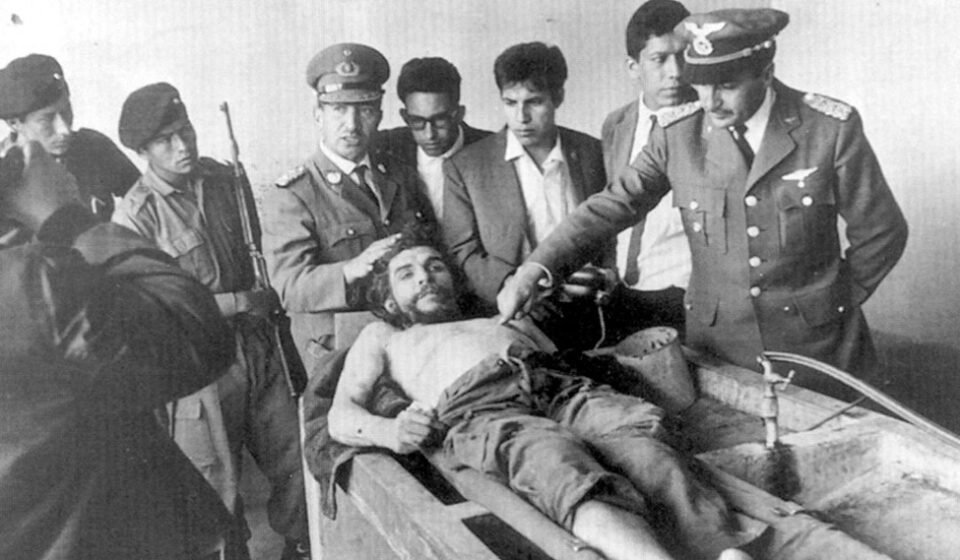
The Bolivian government initially presented Guevara’s death as the result of combat. His body was taken to Vallegrande, where it was displayed to journalists and residents. Military doctors amputated his hands so authorities could use fingerprints to help confirm his identity. His body was then secretly buried near the town’s airstrip.
Found after nearly thirty years
For decades, the burial place remained unknown to the public. In 1997, a team of investigators and forensic experts found a mass grave near the Vallegrande airstrip. The remains identified as Guevara’s were returned to Cuba. On October 17, 1997, they were reburied with military honors in a mausoleum in Santa Clara, the city where Guevara had helped lead a decisive battle in the final weeks of the Cuban Revolution.
The discovery closed one chapter of the story, but not the argument over what Guevara represented.
The man and the image
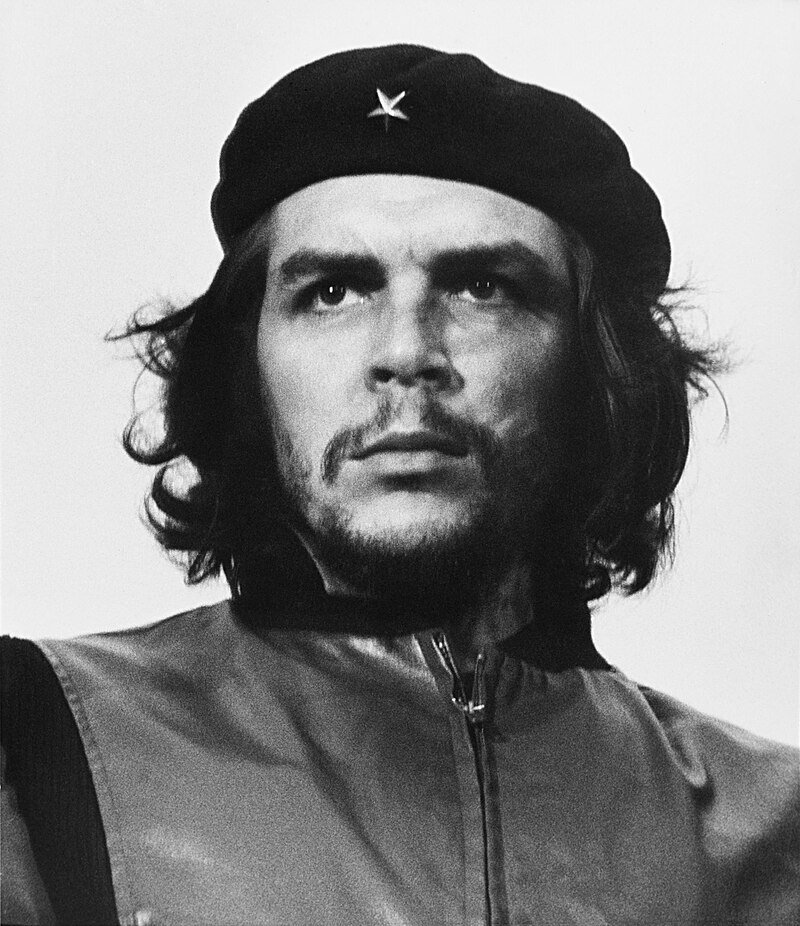
Guevara’s most familiar portrait was not taken in Bolivia. Photographer Alberto Korda captured it in Havana on March 5, 1960, during a memorial gathering for victims of the explosion aboard the French cargo ship La Coubre. Korda titled the photograph Guerrillero Heroico. It later became one of the most widely reproduced political images in the world.
The photograph’s travels have often been simpler than the history behind it. For admirers, Guevara represents sacrifice and opposition to imperial power. For critics, his image conceals the executions he supported, his commitment to armed struggle, and the violence carried out in revolution’s name. Both readings draw on real parts of his life, but neither alone explains the man.
In La Higuera, the famous image was absent. There was only a wounded prisoner in a village schoolroom, a government that refused him a trial, and a soldier ordered to shoot him. The circumstances of his death made him a symbol. The choices he made before it ensure that the symbol remains disputed.
Sources
- Encyclopaedia Britannica, “Che Guevara”. A useful overview of Guevara’s life, political roles, and death.
- Jon Lee Anderson, Che Guevara: A Revolutionary Life. A detailed biography drawing on interviews, archival material, and Guevara’s writings.
- Ernesto Che Guevara, The Bolivian Diary. Guevara’s own account of the campaign, valuable for understanding the guerrillas’ conditions and internal difficulties, while best read alongside independent historical research.
- Che Guevara – Wikipedia