
The story of Scott and Amy Fandel is often told through a striking image: a pot on the stove, food left out, and a cabin that had gone dark. But the detail that matters most is also the one that is easiest to lose among decades of retelling. No one knows exactly what happened inside the cabin, or whether the children were even there when they disappeared.
Scott, 13, and Amy, 8, vanished near Sterling, Alaska, in September 1978. Their last confirmed sighting was at a neighboring family’s home. Despite searches and years of attention, no one has found either child.
A Regular Night, Until It Wasn’t
Margaret Fandel was raising her two children largely on her own that year. Her husband Roger had left the family home earlier in 1978 and relocated to Arizona, leaving Margaret to care for thirteen-year-old Scott and eight-year-old Amy in a rural, forested stretch of the Kenai Peninsula. By most accounts, despite the separation, the kids were doing fine. Scott was small for his age but sharp and fiercely protective of his little sister, the kind of older brother teachers described as a bit of a prankster but also dependable. Amy, according to her mother, was gentle and sweet, the sort of kid who loved dolls, pretty shoes, and being kind to animals.
On the evening of September 4, Margaret took the kids out to dinner at a local bar and restaurant called Good Time Charlie’s, along with her visiting sister, Cathy Schonfelder. Around ten o’clock that night, the two women dropped Scott and Amy back at the cabin and returned to the bar, leaving Scott, old enough by most standards of the era to look after his sister for a few hours, in charge.
The children didn’t stay home alone for long, though. They walked over to a neighboring family’s house, the Luptons, who had five kids of their own and had grown close with Scott and Amy over shared bus stops and afternoons of play. The Fandel children stayed at the Luptons’ until close to midnight, when the noise level apparently got to be too much and the Lupton parents sent them back home to bed.
That was the last confirmed sighting of either child.
An Unsettling Scene
Margaret and Cathy didn’t make it home themselves until two or three in the morning. What greeted them inside the cabin was strange enough to stick with investigators for decades. On the stove sat a pot of water that had clearly been boiling, alongside a package of macaroni and an open can of tomatoes on the counter, the makings of a snack Scott liked to fix himself late at night. None of that, on its own, was unusual.
What was unusual was the darkness. By every account, both children were afraid of the dark and habitually left every light in the cabin burning. When Margaret and Cathy walked in that night, every single light was off.
Accounts differ on whether the two women actually checked the children’s bedroom before going to sleep themselves. Either way, exhausted and likely assuming the kids had simply stayed the night at the Luptons’, both adults went to bed without raising an alarm.
A Slow Realization
The next morning, September 5, Margaret left for work around 8:30, glancing around the cabin but assuming the kids had already headed off to school. Later in the day, she called the school to check on Amy and learned her daughter had never shown up. Worried, she still wasn’t able to leave her job right away.
Cathy, meanwhile, woke up around noon and made the same assumption, that the children were simply at school. It wasn’t until the Lupton kids came by after their own school day, asking where Scott and Amy had been, that anyone realized both children had been missing for well over twelve hours. Cathy called Margaret, and Margaret called the Alaska State Troopers.
A Search That Turned Up Almost Nothing
Investigators combed the cabin and the surrounding wilderness. Search dogs were brought in. Alaska authorities even alerted the Royal Canadian Mounted Police to watch for anyone attempting to cross the border with children matching Scott and Amy’s description. A handful of spent bullet casings were found outside the cabin, though no one could determine how long they had been sitting there or whether they had anything to do with the children at all.
One early lead involved a black sedan reportedly seen speeding down the road near the cabin that night. It turned out to belong to two traveling carnival workers who had stayed at the Fandel cabin briefly weeks earlier, after working the Alaska State Fair. The men said they’d only been in the area to collect their paychecks. No solid evidence ever tied them to the disappearance, though the coincidence of their prior stay, and the fact that they would have known the cabin’s front door didn’t lock properly, has kept that theory alive among armchair investigators for decades.
Family Turning on Family
As is common in cases involving missing children, suspicion quickly turned inward. Roger Fandel accused his own uncle, Herman, of having a hand in the disappearance, a relationship so strained that investigators actually dug up Herman’s yard searching for the children’s remains. Nothing was found. Police also tapped Margaret’s phone for a period, hoping she might say something incriminating. That led nowhere either.
Roger himself had a documented alibi. He had genuinely relocated to Arizona months earlier and flew back to Alaska after hearing the news, reportedly to help with the search. Still, some family members, including a former brother in law who gave an interview decades later, have insisted Roger was somehow involved, possibly through someone else entirely, and have floated theories ranging from a drug deal gone wrong to Roger confronting Margaret and telling her cryptically that “they’re after me, not you.”
Theories That All Fall Apart Somewhere
Few missing persons cases generate as many competing theories as this one, and few hold up cleanly under scrutiny. The idea that the children simply ran away struggles against the facts. Search dogs found no trail. Scott, described as a capable outdoorsman who had completed a wilderness survival course, left behind his prized dirt bike, something investigators find hard to believe he would abandon if he’d planned to leave on his own. And an eight year old girl couldn’t have traveled far on foot in the middle of an Alaskan night.
A wild animal getting into the cabin and frightening the children into the woods sounds dramatic, but doesn’t explain why all the lights, ones the children were terrified to be without, were switched off before whatever happened, happened.
Stranger abduction remains statistically the least likely scenario in most missing children cases, yet in this one it’s oddly difficult to rule out specifically because there’s so little physical evidence either way. Scott’s protective nature toward his sister suggests he would have fought back against an intruder, and neighbors reported hearing no struggle. Unless, as some investigators have speculated, whoever came for the children carried a weapon and never needed to raise their voice.
A Cabin That Later Burned, and Leads That Went Nowhere
The years that followed brought false hope more than once. In 1979, the remains of two children were discovered in the woods near Mendocino, California, initially believed to match Scott and Amy’s descriptions closely enough that investigators held their breath. DNA testing eventually confirmed the remains belonged to two entirely different children who had disappeared from Forestville, California, a case that likewise remains unsolved to this day.
Sometime around 1980, the Fandel family’s cabin, the literal scene of the disappearance, burned to the ground, for reasons that were never made entirely clear.
Then in 1984, a retired Alaska State Trooper who’d worked the case received a tip that a family in Page, Arizona had two children matching Scott and Amy’s descriptions. He flew out personally to investigate. It turned out to be another dead end.
Still Unsolved, Still Open
More than four and a half decades later, the disappearance of Scott and Amy Fandel remains one of Alaska’s oldest unresolved missing children cases. No bodies have ever been recovered. No arrest has ever been made. The physical evidence, a boiling pot, a package of dry macaroni, an open can of tomatoes, and every light in a small cabin switched off in the dark, has never added up to anything conclusive, no matter how many amateur investigators and true crime researchers have picked the case apart online in the decades since.
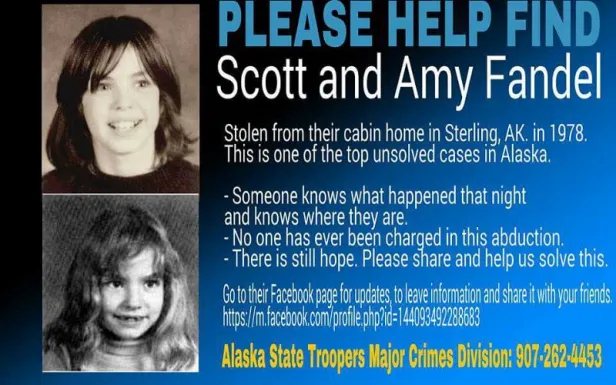
Whatever happened inside that cabin between midnight and the following afternoon, someone likely still knows something. Until they come forward, Scott and Amy remain exactly where they’ve been for forty seven years: gone, without explanation, from a home in the Alaskan woods that never got the chance to turn its lights back on for them.
*Anyone with information about the disappearance of Scott and Amy Fandel is encouraged to contact the Alaska State Troopers.
Sources
Theories Surround Fandel Children’s Disappearance, NBC News.
Amy Fandel: Missing Person Case, International Missing Persons Wiki.