Mercy Dogs: The Four-Legged Medics of the World Wars
Before helicopters, satellite communication, and modern search-and-rescue teams, finding wounded soldiers on a battlefield was slow, dangerous, and often nearly impossible. Men could be trapped in shell holes, hidden beneath rubble, or too weak to call for help. In these circumstances, armies and medical organizations turned to an unusual but highly capable rescuer: the dog.

Known as mercy dogs, ambulance dogs, casualty dogs, or Red Cross dogs, these animals were trained to search for wounded soldiers and guide medical personnel to them. They carried small medical supplies, worked with trained handlers, and sometimes remained beside dying soldiers when help could not arrive in time.
Their work was especially associated with the First World War, although similar programs continued during the Second World War and the Korean War. While many popular accounts describe the dogs as heroic lifesavers, the historical record is more complicated. Numbers differ between sources, some stories have been embellished over time, and not every claim about their abilities can be independently verified. Even so, mercy dogs played a genuine role in the history of battlefield medicine.
The Origins of Mercy Dogs
Organized ambulance-dog programs developed in Europe during the late nineteenth century. Germany was one of the earliest countries to explore the idea systematically.
One important figure was Jean Bungartz, a German artist and animal enthusiast who became involved in training dogs to locate injured people. Accounts differ over the exact date and structure of his early work, but by the 1890s Germany was experimenting with dogs as medical and rescue animals.
The idea soon attracted interest elsewhere. Military and Red Cross organizations in countries such as Italy, Austria, France, and Britain investigated whether dogs could locate wounded soldiers more quickly than human search parties.
Dogs were well suited to the task for several reasons. They had a powerful sense of smell, could move through narrow and damaged terrain, and were able to work at night or in conditions where visibility was poor. They were also smaller and faster than a group of stretcher-bearers and could search areas that were difficult for people to enter.
By the beginning of the First World War, Germany had developed one of the most organized military dog systems in Europe. German medical dogs were commonly known as Sanitätshunde, meaning “medical dogs.”
Mercy Dogs During the First World War
The First World War created an urgent need for casualty-search teams. Artillery bombardments could scatter wounded men over enormous areas. Trenches collapsed, fields became covered in mud and wire, and soldiers were often left behind during advances or retreats.
A wounded soldier might be unable to shout or move. In some cases, he could be lying only a short distance from a trench but remain invisible to human rescuers. A trained dog could detect his scent and alert its handler.
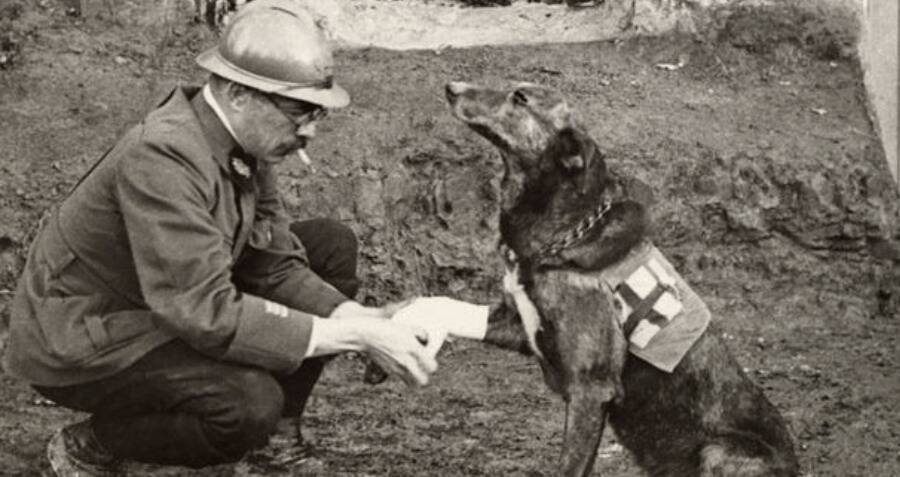
Mercy dogs usually worked with a soldier or Red Cross handler. The handler would send the dog into a search area, often after a battle or during a lull in fighting. The dog was trained to locate wounded people and communicate what it had found.
Depending on the country and the training system, the dog might:
- Remain beside the wounded soldier
- Bark or signal at the location
- Return to its handler and lead rescuers back
- Retrieve a piece of clothing or equipment
- Carry a small medical pack
- Indicate that no casualty had been found
The dogs did not usually provide medical treatment themselves. Their greatest value was helping human medical teams find casualties more quickly.
How Mercy Dogs Were Trained
Training a mercy dog required more than teaching basic obedience. The animal had to work in conditions that were loud, frightening, and filled with unfamiliar smells.

Dogs were trained to search for people hidden in locations such as:
- Trenches
- Fields and woods
- Ruined buildings
- Shell craters
- Shallow piles of debris
- Areas covered by smoke or darkness
They were gradually exposed to battlefield-like conditions, including explosions, gunfire, shouting, smoke, and obstacles. The objective was to prevent the dog from becoming distracted or panicked.
Handlers also taught the dogs how to signal their discoveries. Some dogs stayed with a wounded soldier until the handler arrived. Others returned to the trench or medical station and guided a rescuer back to the casualty.
Some historical accounts state that dogs were trained to distinguish between living and dead soldiers. This would have been extremely useful, since medical workers needed to concentrate on casualties who had a chance of survival. However, claims about a dog’s ability to “triage” patients should be treated cautiously. Dogs could detect scent and signs of life that humans might miss, but they were not making medical judgments in the modern sense.
Equipment Carried by the Dogs
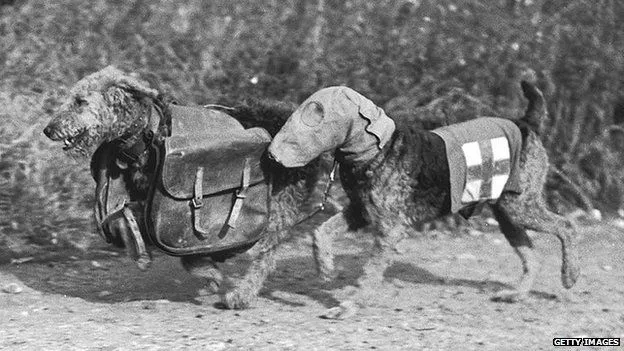
Mercy dogs often wore harnesses or saddlebags marked with medical insignia. Their packs could contain basic supplies such as bandages, water, or other first-aid materials. Some accounts also mention alcohol or spirits being carried for emergency use.
The Red Cross emblem was frequently associated with these animals, particularly when they worked with national Red Cross organizations. The markings helped identify them as part of a medical or rescue service rather than an attack unit.
In practice, however, battlefield markings could not guarantee protection. Mercy dogs still faced artillery, machine-gun fire, barbed wire, collapsing trenches, poison gas, and unexploded ammunition.
Some dogs were fitted with protective equipment, including gas masks, when operating in areas threatened by chemical weapons. Such equipment was difficult to use and could interfere with the animal’s movement, but it reflected the extreme conditions in which these dogs worked.
Britain’s War Dog Program
Britain did not begin the First World War with a large, established military dog service. One of the main advocates for using dogs in medical and military roles was Edwin Hautenville Richardson, a British Army officer and dog trainer.
Richardson had promoted the use of trained dogs before the war. When the British Army showed little initial interest, he worked with the British Red Cross. His efforts eventually helped lead to the creation of the British War Dog School, where dogs were trained for military service.
The school trained dogs for a variety of roles, including messenger and ambulance work. Although the number of dogs trained was modest compared with some continental programs, Britain’s experience helped establish the broader use of dogs by the armed forces.
France and Germany
France also used ambulance dogs during the First World War. French dogs were credited in contemporary accounts with finding wounded soldiers in difficult battlefield conditions. Stories about individual dogs sometimes became widely circulated in newspapers and military publications.
Two dogs often mentioned in accounts of French mercy dogs are Captain and Prusco. Captain was reportedly credited with locating dozens of wounded men in a single day. Prusco was said to have found many casualties during one battle and, in some accounts, pulled wounded soldiers toward shelter before returning for help.
These stories are part of the popular history of mercy dogs, but exact figures are difficult to verify. Wartime newspapers often celebrated animal heroes, and reports could be repeated or embellished. France’s ambulance-dog program also suffered heavy losses, and the country eventually discontinued the service during the war.
Germany maintained one of the largest military dog systems. German dogs were used as messengers, sentries, patrol animals, and medical dogs. Estimates for the total number of German military dogs vary widely because sources do not always distinguish between dogs used for casualty work and those used in other roles.
How Many Mercy Dogs Served?
The number of mercy dogs used during the World Wars is difficult to establish with certainty. Figures vary depending on how researchers define a “mercy dog.”
Some estimates suggest that approximately 10,000 dogs served in casualty-search or ambulance roles during the First World War. Other sources provide broader figures for all military dogs, including messengers, sentries, scouts, and patrol animals.
Germany alone is sometimes credited with training several thousand medical dogs before and during the war. Estimates of total German military-dog use can reach tens of thousands, but those figures include many roles besides battlefield rescue.
For this reason, claims that 20,000 dogs served across both World Wars should be presented as an estimate rather than an established fact. The same caution applies to claims that mercy dogs saved thousands of lives. They almost certainly helped locate wounded soldiers, but the precise number of lives saved cannot be calculated reliably.
The United States and Sergeant Stubby
The United States did not establish a large, independent mercy-dog program during the First World War. American military planners reportedly believed that the war would end before a domestic system could be created.
American Red Cross dogs did serve, and the United States also benefited from trained dogs supplied or borrowed through Allied programs. One of the best-known American war dogs was Sergeant Stubby, a stray dog who became associated with an American Army unit.
Stubby performed several tasks, including warning soldiers of danger and helping locate wounded men. He became one of the most celebrated animals of the war and was given the honorary rank of sergeant.
It is important to clarify one common misconception: Stubby could not have received the Dickin Medal, because that award was created in Britain in 1943, decades after the First World War. His recognition came through military honors, public ceremonies, newspaper coverage, and his honorary rank.
Public Images of Heroic Dogs
Mercy dogs became powerful symbols during wartime. Newspapers, posters, and public speeches presented them as loyal, brave, and almost instinctively compassionate. Their stories helped people at home feel connected to soldiers and the humanitarian work of the Red Cross.
This public image sometimes gave the dogs human qualities. They were described as understanding suffering, choosing the wounded, or displaying extraordinary courage. Some of these descriptions reflected genuine observations, while others were shaped by wartime propaganda and sentiment.
The psychological impact of military service on dogs is also difficult to measure. Modern researchers recognize that animals can experience fear and stress, but historical records rarely describe canine behavior using modern ideas about trauma. It is therefore safer to say that mercy dogs were exposed to extreme stress rather than to claim that they definitively suffered from a specific psychological disorder.
Mercy Dogs in World War II and Korea
The use of casualty dogs did not end in 1918. During the Second World War, Germany again used dogs for several military purposes, including message carrying, guarding, and medical work.
The United States also developed a formal casualty-dog program during the war. The U.S. Army Medical Corps began training dogs in 1942, using breeds such as Pointers and setters. These dogs were associated with medical units and were trained to locate wounded soldiers.
The practice continued into the Korean War. The United States Army used German Shepherds in a casualty-dog program, training them to search for wounded soldiers and lead handlers to their locations. These dogs operated in difficult mountainous terrain and harsh weather, although the program was eventually replaced by newer evacuation and communication systems.
From Military Rescue to Modern Search Dogs
As military medicine advanced, the need for battlefield ambulance dogs declined. Motorized ambulances, helicopters, radios, improved medical evacuation systems, and organized search teams made it possible to locate and transport casualties more efficiently.
The underlying principle, however, remains important. Today, trained dogs are used to find people after earthquakes, avalanches, building collapses, floods, and other disasters. Modern search-and-rescue dogs perform a role closely related to that of the mercy dogs: using scent, endurance, and disciplined training to locate people who cannot easily be found by humans.
Mercy dogs also influenced the way people thought about animals and healing. After the Second World War, dogs increasingly became associated not only with rescue but also with emotional support and rehabilitation. However, therapy-dog programs developed through several different medical and charitable traditions and should not be described simply as a direct continuation of wartime ambulance dogs.
Mercy Dogs in Popular Culture
The story of mercy dogs continues to appear in books, games, documentaries, and public-history projects.
Alison Hart’s historical-fiction book Darling, Mercy Dog introduced young readers to the idea of a World War I rescue dog. The 2014 video game Valiant Hearts: The Great War also features a German medical dog named Walt. In the game, Walt assists the characters and helps communicate the dangers and suffering of the Western Front.
These fictional portrayals are not historical records, but they have helped bring attention to a relatively overlooked aspect of military history.
Conclusion
Mercy dogs were among the earliest organized search-and-rescue animals used in modern warfare. During the First World War, they searched battlefields for wounded soldiers, carried basic supplies, and guided medical personnel to casualties who might otherwise have been missed.
Their history includes genuine acts of bravery, but also stories shaped by wartime publicity and patriotic storytelling. Exact figures for the number of dogs involved and the lives they saved remain uncertain. What is clear is that these animals performed dangerous work under extraordinarily difficult conditions.
The legacy of the mercy dog can be seen today in military working dogs, disaster-response animals, wilderness search teams, and service dogs trained to assist people in crisis. Their story is a reminder that battlefield medicine has never depended only on doctors and machines. Sometimes, it also depended on a trained dog moving through the darkness, searching for someone who still needed help.
Sources
- Wikipedia – “Mercy dog” https://en.wikipedia.org/wiki/Mercy_dog
- Imperial War Museums – Animals in the First World War https://www.iwm.org.uk/history/how-animals-helped-win-the-first-world-war
- National Army Museum – Animals in War https://www.nam.ac.uk/explore/animals-war
- PDSA – Dickin Medal and Animal Heroes https://www.pdsa.org.uk/get-involved/our-campaigns/animal-hero-awards
- U.S. Army Center of Military History https://history.army.mil/
- Library of Congress – Military and First World War Collections https://www.loc.gov/collections/