The Teenager Who Stole a Plane and Hit a Skyscraper
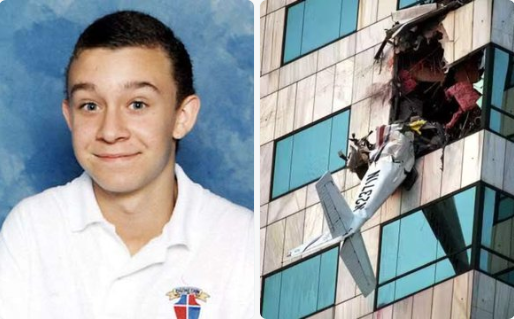
On January 5, 2002, fifteen-year-old Charles J. Bishop took a single-engine airplane from St. Petersburg-Clearwater International Airport in Florida and flew it toward downtown Tampa.
Minutes later, the Cessna 172 struck the Bank of America Plaza, a 42-story office tower, killing Bishop and briefly reviving the fears that had gripped the United States after the September 11 attacks.
No one inside the building was killed or seriously injured. But the crash immediately raised questions about airport security, the vulnerability of general-aviation aircraft, the motives of a troubled teenager, and the possible psychiatric effects of the acne medication he had been taking.

More than two decades later, the incident remains unusual precisely because it was not linked to an organized terrorist plot. Investigators concluded that Bishop acted alone.
A Flight That Was Never Authorized
Bishop was a student at East Lake High School in Tarpon Springs, north of Tampa. He had been taking flight lessons at St. Petersburg–Clearwater International Airport.
On the evening of January 5, he was left briefly with a Cessna 172 while his flight instructor was away from the aircraft. The circumstances were described in contemporary reports as a routine preflight or instructional pause. Bishop was not authorized to take the airplane.

Instead, he started the engine and took off. The aircraft, identified in official reports as a Cessna 172, entered the Tampa Bay area airspace without the permission of its instructor or the airport. Air-traffic controllers and military officials quickly recognized that something was wrong. A U.S. Coast Guard helicopter was sent to intercept the plane and attempted to establish contact with Bishop.
He did not respond. The Cessna continued toward Tampa. Shortly afterward, it hit the Bank of America Plaza near the twenty-eighth floor. The aircraft was destroyed, and Bishop died in the crash. The impact damaged the building, but no one inside was killed.
A Nation Still on Edge
The crash occurred less than four months after the September 11 attacks. A small airplane deliberately flying toward a tall office building therefore produced an immediate national-security scare.
At first, authorities had little information about the pilot or his intentions. The possibility of terrorism could not be dismissed immediately, particularly because the aircraft had ignored warnings and was heading toward a major city.
The Coast Guard helicopter’s attempt to intercept the plane became a central part of the investigation. Investigators also reviewed radar and air-traffic-control records to reconstruct the flight path. Later reports indicated that the Cessna came close to commercial air traffic during its short flight, creating an additional risk even though no airliner was struck.
The incident prompted a review of security at small airports and flight schools. General-aviation facilities typically operate very differently from commercial airports: aircraft may be parked outside, access is often less restricted, and student pilots can have direct access to airplanes. The crash demonstrated how quickly that openness could become a security concern.
The Note
After the crash, investigators found a handwritten note attributed to Bishop. It referred approvingly to Osama bin Laden and the September 11 attacks and expressed anger over American foreign policy in the Middle East.
The note also claimed that Bishop was acting independently. Investigators searched for evidence that he had communicated with al-Qaeda or another terrorist organization, including examining a computer taken from his home.
They found no evidence that Bishop had been recruited, directed, or materially assisted by a terrorist group.
The FBI and other authorities ultimately concluded that the crash was not an organized terrorist attack. The note appeared to reflect Bishop’s own radicalized or imitative thinking rather than an operational connection to al-Qaeda.
That distinction did not make the incident less frightening. It did, however, change the nature of the investigation. Authorities were no longer looking for a wider conspiracy; they were trying to understand why a fifteen-year-old had decided to steal an airplane and use it to kill himself in a highly publicized act.
Questions About Accutane
Bishop had been taking isotretinoin, a prescription acne medication commonly known by the brand name Accutane. At the time, isotretinoin was already the subject of public concern and litigation because of reports alleging an association with depression, suicidal thoughts, and other psychiatric symptoms.
Bishop’s mother, Beverly Bishop, later filed a lawsuit against Roche Laboratories, the drug’s manufacturer. The complaint alleged that isotretinoin had contributed to her son’s mental deterioration and suicide. Reports placed the amount sought at approximately $70 million.
The lawsuit did not establish that the medication caused Bishop’s actions. The relationship between isotretinoin and psychiatric symptoms has remained medically and legally contested, and suicide can have many contributing causes. The case was eventually withdrawn in 2007. According to contemporary reports, Bishop’s mother said she could no longer continue the litigation for health and personal reasons.
The withdrawal left the central question unresolved: whether the medication played any role in Bishop’s behavior, and if so, how significant that role may have been.
Changes at Small Airports
The crash also led the Federal Aviation Administration to examine the security practices surrounding flight schools and general-aviation aircraft.
Unlike commercial airliners, small training aircraft generally do not operate under the same layers of screening and access control. Students may be permitted to work around aircraft with limited supervision, and many small airports rely on familiarity and trust rather than controlled entry points.
Following the Tampa crash, aviation organizations and regulators discussed measures such as better supervision of student pilots, improved aircraft security, and stronger procedures for securing unattended airplanes.
The event did not lead to the complete securitization of general aviation. Small-aircraft operations remain more open than commercial aviation, partly because of the enormous number of private aircraft and small airports in the United States. But the incident became an example of how even a modest training aircraft could be used to create a major emergency.
What the Crash Was and Was Not
The Tampa incident is sometimes described as a terrorist attack because Bishop’s note praised bin Laden and invoked the language of September 11. That description is misleading if it suggests that he belonged to al-Qaeda or acted under its direction.
The available investigation found no evidence of such a connection.
Nor was the crash an accident. Bishop took the plane without authorization, ignored attempts to make contact, and flew toward a populated area. Investigators treated the act as an intentional suicide flight.
The motive appears to have involved a mixture of suicidal intent, anger, imitation, and ideological rhetoric. But because Bishop died immediately, investigators could not question him, and no definitive psychological explanation was ever established.
A Brief Flight, Lasting Questions
Charles Bishop’s flight lasted only a short time. Yet the consequences extended far beyond the few minutes between the unauthorized takeoff and the impact with the Tampa tower.
The crash exposed vulnerabilities at small airports, prompted national concern about copycat terrorism, and became part of the continuing debate over the psychiatric risks associated with isotretinoin. It also left Bishop’s family with questions that could never be answered by the person at the center of them.
He was fifteen years old when he took the aircraft. He had no known connection to a terrorist organization, and no one else died in the building he struck.
What remained was a frighteningly simple sequence: a student pilot left alone with an airplane, an unauthorized takeoff, a note filled with borrowed political language, and a flight that ended against a downtown skyscraper.
The event looked, for a few minutes, like the beginning of another national catastrophe. In the end, it was the isolated act of a suicidal teenager, but one that forced the country to confront how easily a small plane could turn an individual crisis into a public emergency.
Sources
- National Transportation Safety Board. Aircraft Accident Brief: Unauthorised Takeoff and Crash of Cessna 172R, Tampa, Florida, January 5, 2002. NTSB accident number: MIA02FA029. Aircraft registration: N2371N. NTSB Aviation Accident Database: https://www.ntsb.gov/Pages/AviationQuery.aspx Search using MIA02FA029 or N2371N.
- Associated Press. “Teenager Crashes Plane Into Tampa Skyscraper.” January 5–6, 2002. Available through the AP archive and newspapers that published the report: https://apnews.com/ Search: Charles Bishop Tampa plane crash January 2002
- Wikipedia Article,’ 2002 Tampa Cessna 172 crash – Wikipedia
- Federal Aviation Administration. FAA news releases and security guidance issued after the Tampa crash concerning general-aviation aircraft and flight-school security. FAA newsroom: https://www.faa.gov/newsroom Search: Tampa crash January 2002 general aviation security