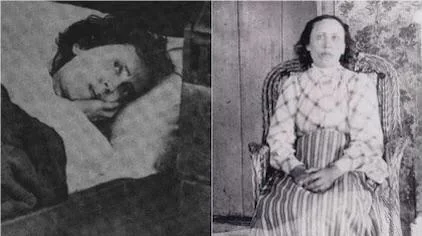
The Sleeper of Oknö
The Unsolved Case of Karolina Olsson
For more than three decades, Karolina Olsson was said to have remained in bed on the Swedish island of Oknö, apparently asleep and almost entirely unresponsive.
She reportedly went to bed in February 1876, when she was fourteen years old, after suffering severe tooth pain. She did not emerge from her room in any ordinary sense until April 1908, at the age of forty-six.

During those 32 years, according to her family and several later medical accounts, Karolina was sustained largely on milk. She was said not to speak, walk, or participate in ordinary life. Yet when she finally became fully alert, she could still read and write and appeared to remember much of what she had learned as a child.
The story has often been presented as a case of miraculous sleep. But the surviving evidence is incomplete, contradictory, and filtered through newspaper reports and later retellings. Modern medicine offers no credible explanation for a person remaining in uninterrupted sleep for 32 years while avoiding the severe muscle wasting, malnutrition, dehydration, and organ damage that such a condition would cause.
Karolina Olsson’s story may be less a record of impossible sleep than a rare and poorly understood psychiatric or neurological disorder, or, as one later investigator suggested, a prolonged form of withdrawal or concealment.
A Girl from Oknö
Karolina Olsson was born on October 29, 1861, on Oknö, an island near Mönsterås on Sweden’s southeastern coast. She was one of five children and the only daughter in the family.
Her father worked as a fisherman, and the household was poor. In February 1876, when Karolina was fourteen, she developed a severe toothache. Later accounts also mentioned that she had suffered a fall or blow to the head, although the details are inconsistent and the medical significance of the injury is uncertain.
The family believed the toothache might have a supernatural cause. According to some accounts, they suspected witchcraft and kept Karolina in bed. Whether that belief began the episode or was simply a later interpretation, Karolina soon became increasingly withdrawn and stopped attending school.
She was said to have refused food and spoken very little, if at all.
Years of Reported Stupor
Karolina’s parents initially cared for her without regular medical supervision. A local midwife and neighbors reportedly tried to help, while her mother gave her milk mixed with sugar or similar nourishment.
Because the family had limited money, they could not immediately obtain sustained medical care. A local doctor eventually examined Karolina and reportedly found her difficult or impossible to rouse. He continued to visit for a period of time and later sought advice from medical colleagues.
The accounts of Karolina’s condition vary considerably. Some say she remained completely motionless, with her eyes closed, for years. Others describe occasional episodes in which she sat up, cried, prayed, or reacted emotionally to events around her.
These inconsistencies matter. A person in a true coma or persistent vegetative state could not survive for decades on two glasses of milk a day. Nor would such a person emerge with preserved movement, memory, and language. The most extraordinary parts of the story, her supposed lack of hair and nail growth, her unchanging physical appearance, and her complete nutritional dependence, were reported by family members and later writers, not documented through continuous modern medical observation.
The Hospital Visit
In 1892, roughly sixteen years after Karolina first became ill, she was taken to a hospital in Oskarshamn for examination.
Later accounts state that doctors diagnosed her with “dementia paralytica,” an old term generally associated with the neurological and psychiatric effects of untreated syphilis. The diagnosis appears difficult to reconcile with the available descriptions of Karolina’s condition, and it was not supported by the kind of testing that would be available today.
Some retellings also say she received electrical treatment at the hospital. It is important not to describe this as electroconvulsive therapy. Modern ECT was not developed until the twentieth century, decades after Karolina’s hospitalization. At most, the historical accounts appear to refer to an early form of electrical or electrotherapeutic treatment.
The treatment reportedly had no obvious effect. Karolina returned home later that year.
The Family’s Account
For the remainder of her reported illness, Karolina was cared for by her mother and, after her mother’s death in 1904, by a household maid.
The family said she consumed little more than milk. One of her brothers died in 1907, and accounts describe Karolina reacting intensely to the death, reportedly crying or becoming agitated despite otherwise remaining withdrawn.
This detail has often been used to suggest that she was not continuously unconscious. It may indicate that she retained some awareness of her surroundings, or it may reflect a later embellishment of the story. The surviving records do not allow the distinction to be made with confidence.
The Awakening
On April 3, 1908, Karolina reportedly emerged from her long state of withdrawal.
The maid found her awake, distressed, and disoriented. She was said to have cried, moved about the room, and reacted painfully to light. She did not recognize people she had known before her illness, including some of her brothers.
Karolina was forty-six years old, but newspaper accounts emphasized that she appeared far younger. Some reports claimed she looked no older than her mid-twenties. Such descriptions should be treated cautiously: they were subjective observations, shaped by the astonishing nature of the story and the conventions of contemporary journalism.
Karolina was reportedly able to read and write after waking. She also appeared to retain childhood knowledge and memories. At the same time, she had to adjust to a world that had changed dramatically during her years of isolation. Telephones, electric lighting, modern transportation, and new social customs had transformed Swedish life since she had last lived normally.
Her case attracted attention in Sweden and abroad. Journalists and physicians sought access to her, and her family reportedly tried to shield her from unwanted publicity.
A Psychiatric Explanation
A psychiatrist identified in English-language accounts as Frödeström examined Karolina around 1910 and later wrote about the case. He did not conclude that she had literally slept without interruption for 32 years.
Instead, he reportedly suggested that Karolina had experienced a form of hysteria, a broad and now outdated diagnosis used for unexplained physical and psychological symptoms. He also considered the possibility that she had periodically awakened or remained partially conscious while continuing to lie still and refuse ordinary interaction.
Later writers have proposed several explanations, including catatonia, dissociation, severe depression, a functional neurological disorder, or deliberate withdrawal. None can be confirmed from the surviving evidence.
The suggestion that Karolina intentionally maintained the appearance of sleep is especially difficult to evaluate. It is based largely on retrospective interpretation, not on a documented confession or a controlled medical examination. Likewise, claims that her mother knowingly helped conceal the truth remain speculative.
The Limits of the Legend
Karolina Olsson’s case is sometimes cited as proof that humans can sleep for decades. There is no reliable medical evidence that this occurred.
A genuine 32-year coma would have produced profound physical consequences. Karolina would have required carefully managed nutrition, hydration, nursing care, and protection from infections and pressure injuries. Her reported survival and apparent recovery do not fit that scenario.
The more plausible possibilities are that she experienced prolonged episodes of catatonia or psychiatric withdrawal, that she retained more awareness than observers realized, or that the family’s account became increasingly stylized over time. It is also possible that several different states- sleep, withdrawal, agitation, and partial responsiveness were compressed into the simple story of “thirty-two years of sleep.”
What happened inside the Olsson household cannot now be reconstructed with certainty.
The End of Her Life
Karolina lived for another 42 years after her reported awakening. She remained on Oknö and largely avoided public attention.
She died on April 5, 1950, at the age of eighty-eight. Later accounts identify the cause of death as an intracranial hemorrhage.
In Sweden, she became known as Soverskan på Oknö—“the Sleeper of Oknö.” Her story survived because it seemed to offer a perfect mystery: a young girl enters bed, the world moves on without her, and an adult woman eventually rises with her childhood memories intact.
But the historical record is less tidy than the legend. There is no proof that Karolina slept continuously for 32 years, no definitive diagnosis, and no reliable explanation for the behavior described by her family and the physicians who encountered her.
Karolina Olsson may have been the victim of a rare psychiatric illness, a neurological disorder, a family misunderstanding, or a story that grew more extraordinary with every retelling. The truth disappeared with the people who knew her best.
What remains is not proof of impossible sleep, but the unsettling record of a young woman whose life became a mystery before modern medicine had the tools to understand it.
Historical information about Karolina Olsson is drawn from Swedish newspaper archives, later medical commentary, and historical summaries of the case. The claim that she slept continuously for 32 years cannot be medically verified. Details concerning her diet, physical appearance, periods of responsiveness, diagnosis, and treatment vary among sources and are presented in this article as reported claims rather than established facts.