The Hidden History of Child Soldiers in WWII
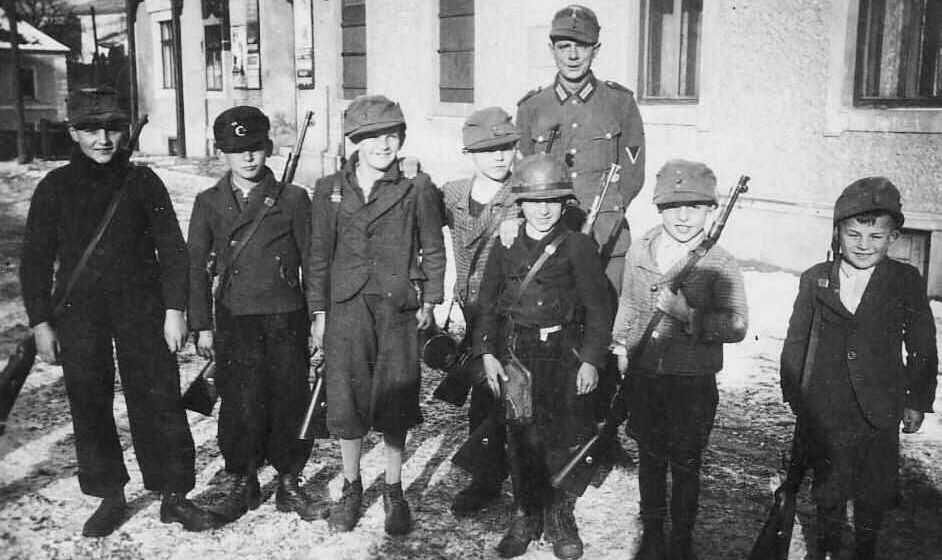
World War II is usually remembered through the actions of adult soldiers, political leaders, and generals. Yet children were also drawn into the conflict in many different ways. Some were recruited or conscripted into military organizations. Others joined resistance movements, served as messengers, carried supplies, gathered intelligence, or fought when their communities came under attack.
The experiences of these children were not all the same. A teenager serving in an organized military unit was in a very different position from a Jewish child resisting Nazi persecution or a young person who lied about their age to enlist. Some were indoctrinated and forced into service, while others joined because they believed resistance was the only way to protect their families and communities.

The use of children during the Second World War was widespread, but it was not uniform. It occurred in dictatorships, occupied countries, resistance movements, and, in more limited ways, within the armed forces of the Allied powers. The war also exposed the weakness of international protections for children, many of which were still developing at the time.
What Counts as a Child Soldier?
The modern term child soldier lacked a universally accepted legal definition during World War II. Today, UNICEF generally uses the term for anyone under 18 who is associated with an armed force or armed group in any capacity. This includes fighters, messengers, porters, cooks, guards, spies, and people used for sexual exploitation.
During World War II, however, national laws and military practices varied considerably. Some countries formally required soldiers to be adults, while others created youth organizations that provided military training or sent teenagers into combat. Many children also entered military service by falsifying their age.
For that reason, historians distinguish between several categories:
- Children formally recruited or conscripted by a state
- Teenagers who volunteered or lied about their age
- Young people serving in military support roles
- Children involved in resistance or partisan movements
- Civilians forced to assist armed groups
- Children used by occupying powers or subjected to military indoctrination
These distinctions matter. The experience of a 16-year-old Waffen-SS recruit was not the same as that of a 14-year-old Jewish courier in an occupied city, even though both were exposed to extreme danger.
Nazi Germany and the Hitler Youth
Nazi Germany developed one of the most extensive systems for militarizing young people. The Hitler Youth, or Hitlerjugend, was created to educate boys according to Nazi racial and political ideology and to prepare them for future service to the German state.
Membership became increasingly compulsory during the 1930s. Boys were trained in physical fitness, discipline, field exercises, navigation, and basic military skills. Girls joined the League of German Girls, known as the Bund Deutscher Mädel. Their training emphasized physical fitness, domestic duties, racial ideology, and preparation for motherhood within the Nazi system.
The Hitler Youth was not originally a frontline military organization. It was, however, designed to make military service appear natural and honorable. Young people were taught loyalty to Adolf Hitler, obedience to authority, and the belief that personal sacrifice for Germany was a moral duty.
As the war continued, the distinction between youth training and military service became increasingly blurred.
Military Training for Teenagers
From 1942 onward, special training camps prepared older Hitler Youth members for military service. Boys between approximately 16 and 18 could receive instruction in weapons, fieldcraft, and infantry tactics. Some were later transferred directly into the German armed forces or the Waffen-SS.
Germany’s growing manpower crisis made the situation worse. As adult men were killed, wounded, or sent to the front, the Nazi government increasingly turned to adolescents. By 1944 and 1945, boys were being used in anti-aircraft units, communications work, local defense formations, and frontline combat.
Some teenagers served as Flakhelfer, or anti-aircraft auxiliaries. These young men and women assisted Luftwaffe personnel in operating anti-aircraft batteries and related equipment. Although many began in support roles, they were still exposed to bombing, artillery fire, and combat conditions.
The 12th SS Panzer Division Hitlerjugend
One of the most notorious examples of Nazi Germany’s use of teenagers was the 12th SS Panzer Division Hitlerjugend.
The division was formed in 1943, using many soldiers born around 1926. Most of the enlisted personnel had come through the Hitler Youth system, while older, experienced officers and noncommissioned officers were assigned to train and command them.
The division fought in Normandy after the Allied landings in June 1944. Its soldiers took part in extremely intense combat around Caen and elsewhere in northern France. The unit suffered heavy casualties, and many of its young soldiers were killed, wounded, or captured.
The division’s history illustrates the danger of describing these recruits simply as “volunteers.” Nazi propaganda, social pressure, indoctrination, and the threat of punishment all influenced young Germans. Many teenagers had been raised to believe that surrender was shameful and that dying for Germany was heroic.
By the final months of the war, Hitler Youth members were also placed in improvised defensive units. During the defense of Germany, especially in the battles around Berlin, some boys were issued anti-tank weapons and sent against Soviet armor with minimal training. Their youth did not protect them from military responsibility; instead, it often made them more vulnerable to manipulation and sacrifice by the Nazi leadership.
The Volkssturm and the Defense of Germany
In October 1944, Nazi Germany created the Volkssturm, a national militia intended to defend German territory. Its members included older men who had not previously served and younger males who were not yet eligible for regular military service.
The precise age range varied in practice, but teenagers were among those drawn into the organization. Some were used as couriers, guards, or local defenders, while others were sent into direct combat.
By 1945, Germany’s military situation had become desperate. Propaganda encouraged boys to see the defense of their towns as a heroic duty. In reality, many were poorly trained and badly equipped. Some were sent against experienced Allied forces with little realistic chance of survival.
Imperial Japan and the Battle of Okinawa
Japan also mobilized young people as the war approached its final stages. As the possibility of an Allied invasion of Japan became more likely, the government and military promoted total national mobilization.
The most tragic example occurred during the Battle of Okinawa in 1945. Japanese authorities organized student units made up of boys and girls. Male students were placed in groups such as the Tekketsu Kinnōtai, often translated as the “Iron and Blood Imperial Corps.” Many were teenagers, commonly between 14 and 17 years old.
Although participation was sometimes described as voluntary, students and schools faced enormous pressure to comply. These young people were used as messengers, stretcher-bearers, laborers, and, in some cases, combatants. Some were ordered to carry explosives toward enemy tanks or participate in guerrilla operations.
Girls were also mobilized. The best-known example is the Himeyuri Student Corps, made up largely of schoolgirls who served as nurses and medical assistants. Many died during the battle as Japanese defenses collapsed.
The use of Okinawan students was part of a broader military culture that emphasized sacrifice, obedience, and death rather than surrender. The students were not trained and equipped like ordinary soldiers, but they were placed in an active war zone and exposed to many of the same dangers.
Jewish Children and Resistance During the Holocaust
Jewish children experienced the war primarily through persecution, deportation, starvation, forced labor, and the threat of murder. Millions were killed during the Holocaust. In this context, Jewish participation in resistance must be understood as an act of survival and opposition to genocide.
Young people played important roles in underground networks. They carried messages, smuggled food and weapons, distributed information, and moved between ghettos and resistance groups. Children were sometimes chosen as couriers because they attracted less suspicion than adults.
Jewish youth movements, including Hashomer Hatzair, helped organize education, mutual aid, underground communication, and armed resistance. In the Warsaw Ghetto, young Jewish fighters played a major role in the Warsaw Ghetto Uprising of 1943.
Jewish resistance groups also operated outside the ghettos. In France, the Armée Juive, or Jewish Army, helped rescue Jews, move people across borders, and participate in armed resistance. Young people were involved in several of these activities, although it is important not to assume that every participant was a child.
Unlike the use of children by Nazi Germany or Imperial Japan, the participation of Jewish youth in resistance was generally a response to persecution and the destruction of their communities. Their actions were shaped by survival rather than by a state program of militarization.
Children in the Soviet Union
The Soviet Union also had children and teenagers associated with the Red Army, although official military service was generally intended for adults.
Some young people became known as “sons of the regiment.” These were often war orphans or children separated from their families. They might be informally adopted by military units and used as messengers, scouts, assistants, or camp helpers. Some eventually took part in dangerous military operations.
The reality varied from unit to unit. A child might be treated as a mascot or helper, while another might perform reconnaissance or carry messages under fire. Soviet propaganda later celebrated these young figures as symbols of patriotism and courage.
The Soviet Union also suffered the invasion and occupation of much of its western territory. Children sometimes joined partisan groups or assisted them by gathering intelligence, carrying supplies, and observing enemy movements.
Children in the Polish Resistance
Poland’s occupation created one of the largest and most developed underground movements in Europe. Young people played a major role in resistance work, particularly as messengers, couriers, scouts, and distributors of underground newspapers.
The Grey Ranks, or Szare Szeregi, were an underground organization connected with the Polish Scout movement. Its members were divided into age-based groups. Younger children generally performed support and educational duties, while older teenagers received more advanced training and took part in sabotage, intelligence gathering, and armed operations.
Some young Polish resistance members participated in Operation Tempest and the Warsaw Uprising of 1944. During the uprising, teenagers served as couriers, medical assistants, ammunition carriers, and fighters.
Children were especially valuable as messengers because they could sometimes move through occupied cities more easily than adult resistance members. Even so, their work was extremely dangerous. Many were arrested, tortured, or killed by German forces.
Britain and the Home Guard
Britain’s use of young people during World War II was more limited and more regulated than the German or Japanese systems. The Home Guard was created in 1940 after fears of a German invasion. It was intended to defend local communities, guard important sites, and support the regular armed forces.
The Home Guard was popularly known as “Dad’s Army” because many members were older men who were too old for regular military service. However, some teenagers also became involved, particularly through cadet organizations and local volunteer structures.
Official age requirements changed and were not always applied consistently. Some boys under 18 managed to join or perform auxiliary duties, but Britain did not organize children into large frontline formations comparable to the Hitler Youth division or the Okinawan student units.
More than a thousand Home Guard members died during the war, many as a result of German bombing. Their deaths demonstrate that even local defense work could expose volunteers to serious danger.
The United States and Underage Enlistment
U.S. military regulations generally required recruits to meet minimum age requirements. Seventeen-year-olds could enlist with parental consent, while younger boys were not legally eligible for regular service.
Despite these rules, some teenagers lied about their age. The most famous example is Calvin Leon Graham, who enlisted in the U.S. Navy at the age of 12. He served aboard the USS South Dakota during the Battle of Guadalcanal and was wounded. His real age was discovered afterward, and he was discharged.
Graham’s story is unusual, but it was not entirely unique. Wartime recruiting systems relied heavily on documentation and personal declarations, making it possible for some determined teenagers to enter service illegally.
These cases should not be confused with an official U.S. policy of recruiting children. The American military did not create a formal child-soldier program during World War II.
International Law and the Protection of Children
International law offered children limited protection during World War II. The 1924 Geneva Declaration of the Rights of the Child recognized that children required special care and protection, but it was not a comprehensive system for preventing their recruitment or use in armed conflict.
There was also no universally accepted international definition of a child soldier. National laws differed, and many military systems treated older teenagers as nearly equivalent to adults.
After the war, legal protections gradually expanded. The 1949 Geneva Conventions and the 1977 Additional Protocols introduced stronger protections for children during armed conflict. The 1977 protocols prohibited the recruitment and direct participation in hostilities of children under 15, although the rules were not yet equivalent to today’s 18-year standard.
The Convention on the Rights of the Child, adopted in 1989, established a much broader framework for children’s rights. The Optional Protocol on the involvement of children in armed conflict, which entered into force in 2002, strengthened international standards and encouraged states to prevent the forced recruitment and direct participation of children under 18.
The Rome Statute of the International Criminal Court defines the conscription, enlistment, or use in hostilities of children under 15 as a war crime. Modern international policy increasingly treats children associated with armed groups as victims in need of protection, rehabilitation, and reintegration.
Why Children Were Used
Governments and armed groups used children for several reasons:
- Children were easier to indoctrinate and control.
- They could be trained to obey authority without questioning orders.
- Teenagers were physically capable of carrying weapons or supplies.
- Children could move through cities and checkpoints without attracting the same suspicion as adults.
- States facing military defeat experienced severe manpower shortages.
- Propaganda presented youthful sacrifice as patriotic and honorable.
- Some children joined voluntarily to protect their families or resist occupation.
In nearly every case, children were placed at extraordinary risk. Their age made them especially vulnerable to propaganda, coercion, fear, and manipulation.
Conclusion
Children’s involvement in World War II took many forms. Some were indoctrinated by totalitarian governments and sent into battle. Others served in support roles, joined resistance movements, carried messages, or lied about their age to enlist. Jewish children resisted persecution under conditions of genocide, while young people in Poland and the Soviet Union helped underground movements and partisan groups.
These experiences should not be treated as a single story. A child recruited by the Nazi state, a Japanese student forced into battlefield service, a Jewish courier fighting for survival, and an American teenager who illegally joined the Navy all faced different circumstances.
What connects them is the extraordinary vulnerability of children in wartime. World War II demonstrated how quickly governments and armed groups could turn young people into instruments of war when legal protections were weak and societies were mobilized for total conflict.
The international standards created after 1945 were shaped in part by these failures. Although child recruitment and child participation in armed conflict have not disappeared, modern law recognizes that children associated with armed forces are generally victims first—not simply soldiers, criminals, or symbols of national glory.
Sources and Further Reading
- United States Holocaust Memorial Museum – Children During the Holocaust https://encyclopedia.ushmm.org/content/en/article/children-during-the-holocaust
- United States Holocaust Memorial Museum – Jewish Resistance https://encyclopedia.ushmm.org/content/en/article/jewish-resistance
- The Wiener Holocaust Library – The Warsaw Ghetto Uprising https://www.theholocaustexplained.org/resistance-responses/armed-resistance/warsaw-ghetto-uprising/
- Imperial War Museums – The Hitler Youth https://www.iwm.org.uk/history/the-hitler-youth
- United States Holocaust Memorial Museum – Hitler Youth https://encyclopedia.ushmm.org/content/en/article/hitler-youth
- Encyclopaedia Britannica – Hitler Youth https://www.britannica.com/topic/Hitler-Youth
- Encyclopaedia Britannica – Battle of Okinawa https://www.britannica.com/event/Battle-of-Okinawa
- UNICEF – Children and Armed Conflict https://www.unicef.org/protection/children-and-armed-conflict
- Office of the United Nations Special Representative for Children and Armed Conflict https://childrenandarmedconflict.un.org/
- International Committee of the Red Cross – Children and Armed Conflict https://www.icrc.org/en/war-and-law/protected-persons/children
- United Nations – Optional Protocol on the Involvement of Children in Armed Conflict https://www.ohchr.org/en/instruments-mechanisms/instruments/optional-protocol-convention-rights-child-involvement-children
- International Criminal Court – Rome Statute https://www.icc-cpi.int/sites/default/files/Publications/Rome-Statute.pdf
- U.S. Naval History and Heritage Command – Calvin Graham https://www.history.navy.mil/